

The global automotive landscape has undergone an extraordinary evolution over the past decade, moving from a niche alternative market to a dominant force driven by battery electric vehicles. Yet, despite the massive proliferation of electric cars on highways worldwide, mainstream consumer adoption continues to battle against a few lingering psychological and practical barriers. Drivers still worry about range anxiety during cross-country road trips, lengthy charging stops at crowded public stations, and the long-term degradation of expensive battery packs.
While incremental improvements in traditional lithium-ion chemistry have steadily pushed performance forward, the underlying technology is rapidly approaching its theoretical physical limits. Enter the solid-state battery, a technological breakthrough widely hailed by engineers and researchers as the holy grail of energy storage. By replacing the volatile liquid or gel electrolytes found in conventional batteries with a solid material, this next-generation architecture promises to obliterate the remaining hurdles of electric mobility. As major automakers and advanced tech startups race to scale production, solid-state technology stands poised to completely transform the automotive industry.
The Architectural Flaw of Liquid Electrolytes
To understand why solid-state batteries represent such a monumental leap forward, one must first examine the limitations of the technology currently powering almost every electric vehicle on the road. Standard lithium-ion batteries rely on liquid electrolytes to facilitate the movement of lithium ions back and forth between the cathode and the anode during charging and discharging cycles.
While liquid electrolytes work well, they carry inherent chemical and physical vulnerabilities. First and foremost is thermal stability. Under extreme conditions, such as rapid charging, heavy high-performance driving, or physical damage from an accident, liquid electrolytes can experience a phenomenon known as thermal runaway. This chemical chain reaction generates intense heat, breaks down the electrolyte, and can lead to catastrophic battery fires.
Furthermore, liquid-based batteries require bulky thermal management systems, heavy protective casing, and complex cooling networks to keep operating temperatures stable. These structural requirements add massive weight to the vehicle, which in turn diminishes overall efficiency. Worst of all, traditional liquid electrolytes are prone to forming microscopic metallic filaments called dendrites over time. If these dendrites grow long enough to pierce the separator barrier between the electrodes, they cause a short circuit, permanently degrading the battery or triggering a failure.
How Solid-State Technology Changes the Equation
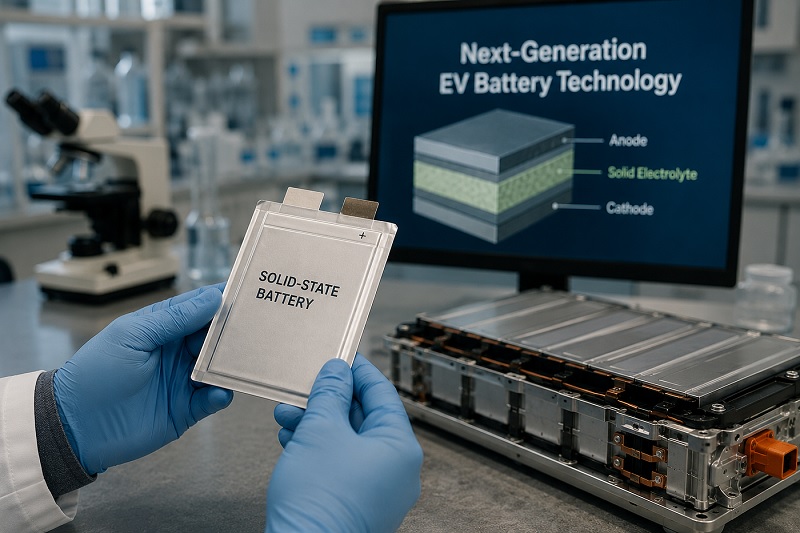
Solid-state batteries eliminate the liquid electrolyte entirely, substituting it with a solid ceramic, glass, or solid polymer material. This structural shift fundamentally alters the physics of energy storage and unlocks a cascade of performance benefits.
Unprecedented Energy Density and Range
Because solid electrolytes are chemically stable and physically robust, engineers can pack significantly more energy into a much smaller and lighter space. Solid-state cells boast a dramatically higher energy density than conventional lithium-ion cells. In practical terms, a solid-state battery pack can weigh half as much as a traditional battery while storing double the amount of electrical energy. This means future electric vehicles could easily shatter the six-hundred-mile barrier on a single charge, completely eliminating range anxiety without requiring massive, heavy battery packs that weigh down the chassis.
Lightning-Fast Charging Times
One of the most persistent frustrations of electric vehicle ownership is the time spent tethered to a DC fast charger. While plugging in for thirty to forty-five minutes is manageable during a road trip, it pales in comparison to the five-minute experience of filling a gas tank.
Solid-state batteries can accept high-voltage electrical currents at an astonishing rate without the risk of overheating or degrading the internal structure. Because solid materials facilitate rapid ion transport and resist dendrite formation, research prototypes have demonstrated the ability to recharge from ten percent to eighty percent capacity in less than ten minutes. This capability bridges the convenience gap between electric vehicles and traditional internal combustion cars, making long-distance travel entirely seamless.
Overcoming the Manufacturing and Scaling Hurdle
If solid-state batteries offer such staggering advantages, why are they not already powering every new car on the showroom floor? The answer lies in the immense complexity of manufacturing these advanced cells at a commercial scale.
Transitioning from liquid chemistry, which can be easily poured and injected into battery casings during mass production, to solid materials requires entirely new industrial techniques. Solid electrolytes must be processed in ultra-clean, moisture-controlled environments to prevent contamination. Furthermore, as the battery charges and discharges, the solid materials expand and contract. Maintaining continuous physical contact between the solid electrolyte and the electrodes across thousands of expansion cycles without cracking the brittle ceramic material has proven to be an extraordinary engineering challenge.
Despite these hurdles, billions of dollars are flowing into research and development. Automakers including Toyota, Nissan, and BMW, alongside specialized battery developers, are aggressively constructing pilot manufacturing facilities. While initial consumer deployments will likely debut in low-volume, high-end luxury and performance vehicles, manufacturing efficiencies are expected to drive production costs down over the latter half of the decade, paving the way for mass-market integration.
The Broader Impact on Automotive Design and Society
The widespread adoption of solid-state batteries will ripple far beyond simple battery packs, triggering a fundamental redesign of how electric vehicles are engineered, manufactured, and utilized.
Redefining Vehicle Architecture and Weight
In a traditional electric vehicle, the battery pack is the heaviest component, often weighing over a thousand pounds and dictating the structural layout of the entire chassis. By cutting that weight in half and shrinking the physical volume required for energy storage, automotive designers gain unprecedented freedom. Lighter vehicles require smaller electric motors, thinner suspension components, and less structural reinforcement, creating a virtuous cycle of efficiency. Handling, braking performance, and interior passenger space will all see dramatic improvements.
Enhanced Safety and Environmental Longevity
The safety implications of removing flammable liquid electrolytes cannot be overstated. Solid-state batteries are virtually immune to thermal runaway under normal operating conditions, eliminating the risk of catastrophic battery fires. This stability reduces the need for heavy, complex liquid cooling systems and steel armor plating underneath the vehicle.
Additionally, solid-state batteries suffer from significantly lower capacity degradation over time. Because they resist the chemical wear and tear that plagues traditional lithium-ion cells, these next-generation packs could easily outlast the lifespan of the vehicle itself, dramatically improving the long-term residual value of electric cars and bolstering the secondary used-car market.
The solid-state battery revolution represents much more than a simple upgrade to a car part. It is the technological tipping point that will propel electric mobility from an eco-conscious alternative into the undisputed, superior standard of global transportation. By solving the challenges of range, charging speed, safety, and weight, solid-state technology is set to redefine our relationship with the automobile, ensuring a cleaner, faster, and entirely frictionless future on the road.

Comments are closed.