

If you drive long enough, sooner or later you’ll see that dreaded amber light glow on the dashboard — the check engine warning. In the past, deciphering its meaning meant a trip to the dealer, often with a hefty diagnostic fee attached. Today, thanks to the OBD2 (EOBD in the UK and Europe) standard, anyone can buy a diagnostic tool to communicate with their car’s computer. The question is: which tool is right for you? With options ranging from simple plug-in code readers to advanced professional scanners, making the right choice can save you time, money, and plenty of frustration.
Understanding OBD2 and EOBD
Since 2001 for petrol cars and 2004 for diesels, vehicles sold in the UK and Europe have been fitted with a standardised diagnostic port. Known as OBD2 or EOBD, this system allows diagnostic equipment to read and clear engine fault codes, display live sensor data, and confirm whether emissions-related checks are complete. Every compliant car has the same 16-pin socket, usually hidden under the dashboard, which means that in theory, one tool could work for all cars.
In practice, though, not every tool can access every part of a vehicle. All scanners will communicate with the engine and emissions systems via the generic OBD-II protocol which was initially designed for emissions reasons, but many will not reach the ABS, airbags, or body modules unless they support proprietary manufacturer protocols, that’s where that’s why it pays to think carefully before buying. At Albionshire Diagnostics we help car owners and professionals choose the right scan tools for their specific needs.
Different Types of OBD2 Tools
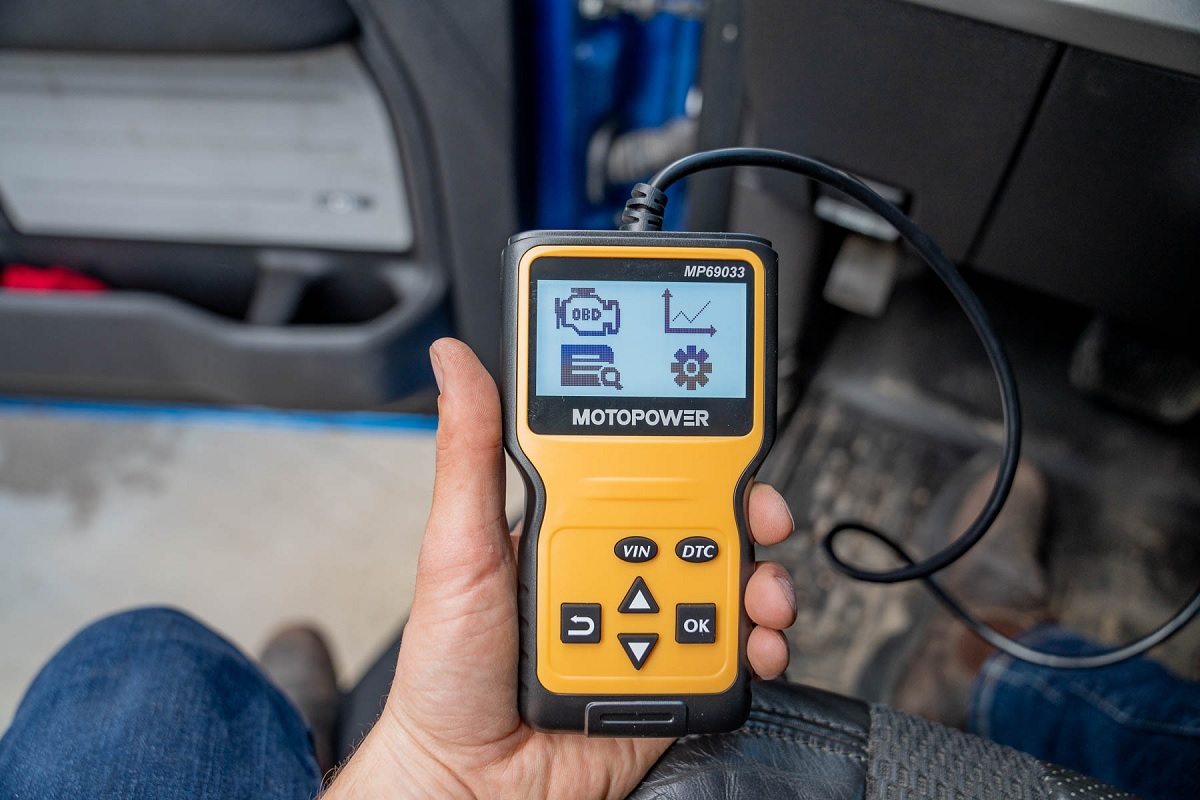
The simplest option is scanners supporting the generic OBD-II protocol. For example the THINKOBD 20. These basic and in-expensive devices do exactly what some people might need if they are only interested in basic engine diagnostics — they read and clear engine codes only, display freeze-frame information, and show live data like oxygen sensor readings or air-flow values. For drivers who simply want to check what triggered the warning light / check engine light (MIL) before an MOT, this can give some clues but it won’t give you the whole picture. There are some engine codes that are manufacturer specific that won’t get scanned by the generic OBD-II protocol that’s why it’s important to understand the difference between the OBD-II protocol and proprietary manufacturer protocols.
A popular and cost-effective alternative to traditional diagnostic tools are smartphone-compatible OBD-II scanners. These compact devices plug directly into your car’s OBD-II port and connect wirelessly to your phone, transforming it into a powerful car diagnostic tool. Because the only hardware needed is the small OBD-II dongle, manufacturers can keep costs low while still providing advanced vehicle diagnostics at your fingertips. The downside is that quality varies enormously. Cheap adapters, often sold under generic names, can be slow or unreliable. If you need support for multi-brand vehicles and more advanced capabilities, phone-based diagnostics have some catching up to do. Choosing a well-supported option is essential if you want comprehensive coverage.
Enthusiasts and families with multiple cars often prefer more advanced single or multi-brand handheld scanners such as the iCarsoft VAW V3.0 or the iCarsoft CR MAX. These provide dealer level coverage, reading control modules such ABS, resetting airbags, and even service functions such as oil resets, electronic parking brake retraction, injector coding and battery registration. They cost more, but they provide more comprehensive coverage and allow you to quickly carry out complex repairs with greater reliability.
Finally, there are professional workshop-grade scanners. These tablet-style devices or PC-based systems provide more advanced dealer-level access, enabling bi-directional testing, coding, adaptations and programming ECUs. For example, a mechanic can command a cooling fan to run or reprogram a new sensor or replace the entire ABS control module or retro fit headlights. At Albionshire Diagnostics, we are dedicated to serving both garage professionals and DIY enthusiasts. Our mission is simple: to make independent high-grade dealer-level diagnostic tools accessible to all, ensuring garage professionals can get work done efficiently and reliably whilst empowering DIYers to tackle some repairs on their own.
Key Considerations Before You Buy
The most important factor is compatibility. While OBD2 ensures basic engine access, not all scanners cover every car brand or every system within the vehicle. Always check the tool’s compatibility list for your make, model, and year. Hybrids and electric cars, for example, often require more specialised equipment.
Ease of use should also guide your decision. A well-designed menu system, clear fault code definitions, and the ability to save or export data can make diagnostics much easier. Features such as automatic VIN recognition save time and reduce mistakes, while lifetime software updates add long-term value. At Albionshire Diagnostics we often advise customers to look for tools with solid support and regular updates rather than chasing the lowest price.
Another consideration is what you intend to do with the results. Reading a code is only the first step; interpreting it correctly requires context. A fault code pointing to an oxygen sensor doesn’t always mean the sensor itself is broken — it could indicate a wiring fault or an exhaust leak. A good scanner helps you go beyond the code by displaying live data, freeze-frame snapshots, and readiness monitors and even providing guided functions for common procedures an example is the VAG guided function found in our TOPDON PHOENIX range.
Avoiding Common Mistakes
One of the biggest misconceptions is that any OBD2 tool can “fix” a car. In reality, scanners report symptoms, not causes. Clearing codes without addressing the fault will only see the light return, sometimes accompanied by even more problems. Another common mistake is assuming that all scanners offer ALL systems access. Many only cover the engine, leaving you unable to diagnose ABS or airbag lights.
The Right Tool for the Right Job
There is no universal “best” OBD2 scanner — only the tool that best matches your car, your budget, and your level of confidence. For occasional use, a basic handheld reader is more than adequate for engine diagnostics only. For those who enjoy maintaining their own vehicles, a mid-range scanner with service functions is a wise investment. And for workshop professionals or dedicated enthusiasts, a tablet-style scanner or manufacturer-specific interface offers unrivalled depth.

Comments are closed.